This glossary is about Social Science. Social science is the branch of science devoted to the study of societies and the relationships among individuals within those societies. The term was formerly used to refer to the field of sociology, the original "science of society", established in the 19th century. In addition to sociology, it now encompasses a wide array of academic disciplines, including anthropology, archaeology, economics, human geography, linguistics, management science, media studies, political science, psychology, and social history. I made this glossary to help students understand some words that are use frequently.
biology
noun
The study of living organisms, divided into many specialized fields that cover their morphology, physiology, anatomy, behavior, origin, and distribution.
Example: He studies biology.
fr: biologie
brain
noun
An organ of soft nervous tissue contained in the skull of vertebrates, functioning as the coordinating center of sensation and intellectual and nervous activity.
Example: He has a big brain.
fr: cerveau
communication
noun
The imparting or exchanging of information or news.
Example: Communication is key for a good relationship.
fr: communication
consumption
noun
The using up of a resource.
Example: In response to the 1997 Asian financial crises, Thai prime-minister Thaksin tried to boost domestic consumption by increasing government-spending as loans to villagers.
fr: consommation
culture
noun
The customs, arts, social institutions, and achievements of a particular nation, people, or other social group.
Example: It would surely seem that the word 'God', certainly in the manner Descartes understands it, if not the majority of Western culture, is a singular expression, not a general one.
fr: culture
democracy
noun
A system of government by the whole population or all the eligible members of a state, typically through elected representatives.
Example: He claims to appreciate the controversial nature of the policy he is about to propose as a part of "democracy".
fr: démocratie
economy
noun
The wealth and resources of a country or region, especially in terms of the production and consumption of goods and services.
Example: The country has a great economy.
fr: économie
environment
noun
The surroundings or conditions in which a person, animal, or plant lives or operates.
fr: environnement
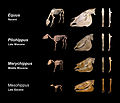
evolution
noun
the process by which different kinds of living organisms are thought to have developed and diversified from earlier forms during the history of the earth.
Example: The evolution of the human race.
fr: évolution
geography
noun
The study of the physical features of the earth and its atmosphere, and of human activity as it affects and is affected by these, including the distribution of populations and resources, land use, and industries.
Example: We talked about geography yesterday.
fr: géographie
history
noun
The study of past events, particularly in human affairs.
Example: He marked the history of the country.
fr: histoire
moral
adjective
Concerned with the principles of right and wrong behavior and the goodness or badness of human character.
Example: Traditionally altruism has been explained either in terms of advantage to the genes; you are altruistic towards your children because they are the only direct way your genes can be carried on into future generations; you are altruistic toward fellow men because you may get aid in return, or in terms of a true morality, an independent moral conscience or a spiritual essence in humans that overcomes the selfish dictates of our genes; a view which finds little favour with scientists (Blackmore, 1999).
fr: moral
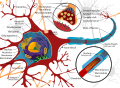
neuron
noun
A specialized cell transmitting nerve impulses; a nerve cell.
Example: We have neurons in our brain.
fr: neurone
politic
noun
The activities associated with the governance of a country or other area, especially the debate or conflict among individuals or parties having or hoping to achieve power.
Example: Opinions on politics are hard to share with others.
fr: politique
population
noun
A particular section, group, or type of people or animals living in an area or country.
Example: The country has a dense population.
fr: population
psychology
noun
The scientific study of the human mind and its functions, especially those affecting behavior in a given context.
Example: He studies psychology.
fr: psychologie
research
noun
The systematic investigation into and study of materials and sources in order to establish facts and reach new conclusions.
Example: We are doing a research in our class.
fr: recherche
resources
noun
A stock or supply of money, materials, staff, and other assets that can be drawn on by a person or organization in order to function effectively.
Example: This phenomenon did not work out well for Shostak as she complained that it was becoming impossible to sustain the villagers demands, in addition this had implications for life after the researcher leaves the community, as they live communal life, sharing resources, and occasionally working in exchange for goods (1990:27).
fr: ressources
society
noun
The aggregate of people living together in a more or less ordered community.
Example: We live in society.
fr: société
stock
noun
The capital raised by a business or corporation through the issue and subscription of shares.
Example: Further more, according to 1994 readings the Netherlands has the largest proportion of social rented housing in the Europe, amounting to 36% of the country's total stock, compared to the EU average of just 18%.